
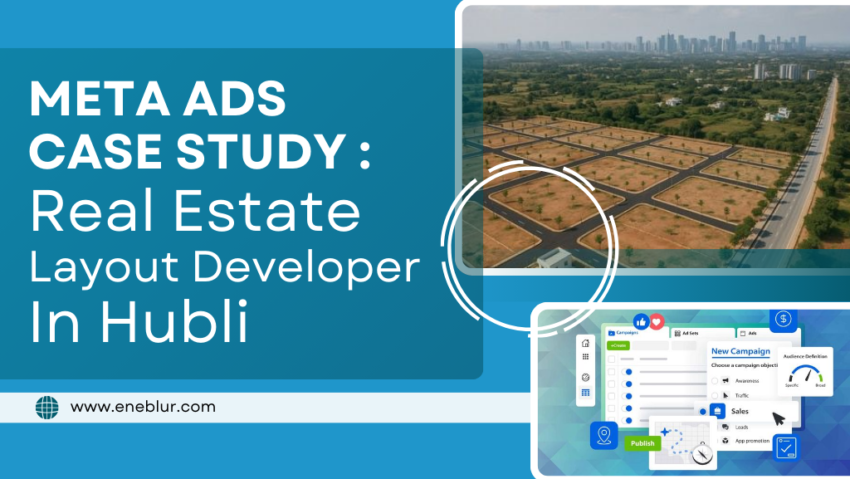
Digital advertising has become a critical growth driver for real estate developers, especially in tier-2 cities like Hubli where buyer intent is strong but competition continues to grow. Meta Ads, when executed with the right strategy, can deliver consistent and measurable results instead of short-term visibility spikes. This case study explains how a real estate layout developer in Hubli leveraged Meta Ads to build a predictable, cost-efficient lead generation system.
The campaign focused not only on reach, but on attracting serious buyers who were more likely to convert into site visits and sales discussions.
Client Background and Market Challenge
The client is a residential layout developer operating in and around Hubli, targeting both end-users and long-term land investors. While interest in plotted developments was high, earlier marketing efforts resulted in inconsistent lead quality and uneven inquiry flow. Sales teams spent significant time filtering casual inquiries, which affected overall efficiency.
The key requirement was a structured digital strategy that could generate steady demand while maintaining control over acquisition costs.
Campaign Objective and Duration
The campaign was launched with a clear objective of lead generation using Meta’s instant lead forms. This approach reduced friction for users and improved form completion rates. The campaign ran from 1 November 2025 to 28 January 2026, allowing sufficient time for algorithm learning, creative testing, and continuous optimization.
Audience Targeting and Funnel Strategy
Targeting focused on users located in Hubli and nearby regions with interests related to real estate, property investment, land ownership, and home buying. Behavioral and engagement-based signals were prioritized over broad demographic filters.
A funnel-based structure was implemented. Cold audiences were introduced through awareness-focused creatives, while users who engaged with ads were retargeted with lead-driven messaging. This helped improve intent quality without increasing costs.
Creative and Messaging Approach
Creatives emphasized layout planning, accessibility, and long-term investment value instead of aggressive pricing or urgency-driven promotions. Local familiarity played a key role, as layout-specific visuals performed better than generic real estate imagery.
Ad copies were written with clarity and transparency, helping users understand what information they would receive after submitting the form. This reduced low-quality inquiries and improved trust at the first interaction.
Performance Overview
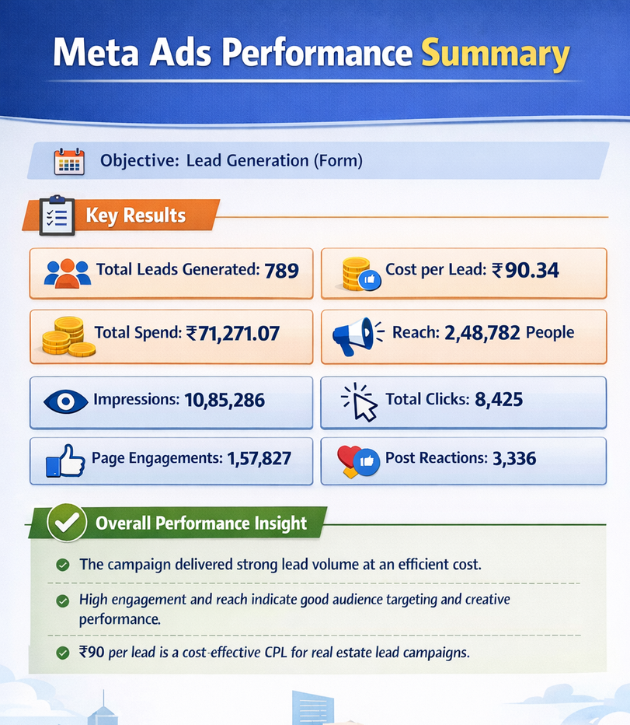
The campaign reached 2,48,782 people and generated 10,85,286 impressions, ensuring strong and consistent visibility across Meta platforms. This resulted in an average frequency of approximately 4.3, supporting brand recall without causing ad fatigue.
A total of 8,425 clicks were recorded. Engagement remained strong, with 1,57,827 page engagements and 3,336 post reactions, indicating active user interaction with the ads.
Lead Generation and Cost Efficiency
Over the campaign period, 789 leads were generated with a total ad spend of ₹71,271.07. The average cost per lead was ₹90.34, which is highly cost-effective for real estate layout campaigns in comparable markets.
Sales follow-ups indicated higher site visit intent compared to previous digital campaigns, reducing time spent on unqualified inquiries and improving downstream conversion potential.
Lead Generation and Cost Efficiency
Over the campaign period, 789 leads were generated with a total ad spend of ₹71,271.07. The average cost per lead was ₹90.34, which is highly cost-effective for real estate layout campaigns in comparable markets.
Sales follow-ups indicated higher site visit intent compared to previous digital campaigns, reducing time spent on unqualified inquiries and improving downstream conversion potential.
Optimization and Key Learnings
Continuous optimization was critical to sustaining performance. Underperforming creatives were paused early, while high-performing ads were gradually scaled. Lead form fields were refined to balance ease of submission with relevance, improving completion quality.
Audience behavior analysis showed higher engagement during evening hours, which was leveraged to improve delivery efficiency and consistency.
Why This Strategy Worked in Hubli
Hubli’s real estate audience responds better to trust-based communication than urgency-driven messaging. By aligning ad creatives with local buyer behavior and maintaining consistent visibility, the campaign attracted decision-ready prospects instead of passive browsers.
Conclusion
This Meta Ads case study demonstrates how a structured, data-driven approach can deliver predictable growth for real estate layout developers in Hubli. By combining precise audience targeting, locally relevant creatives, and continuous optimization, the campaign generated consistent lead flow while maintaining strong cost efficiency and brand credibility in a competitive market.
For developers aiming to build a reliable digital acquisition system through Meta Ads services in Hubli, partnering with an experienced performance marketing team can create a measurable advantage. To explore proven strategies and real-world case studies, visit https://www.eneblur.com.